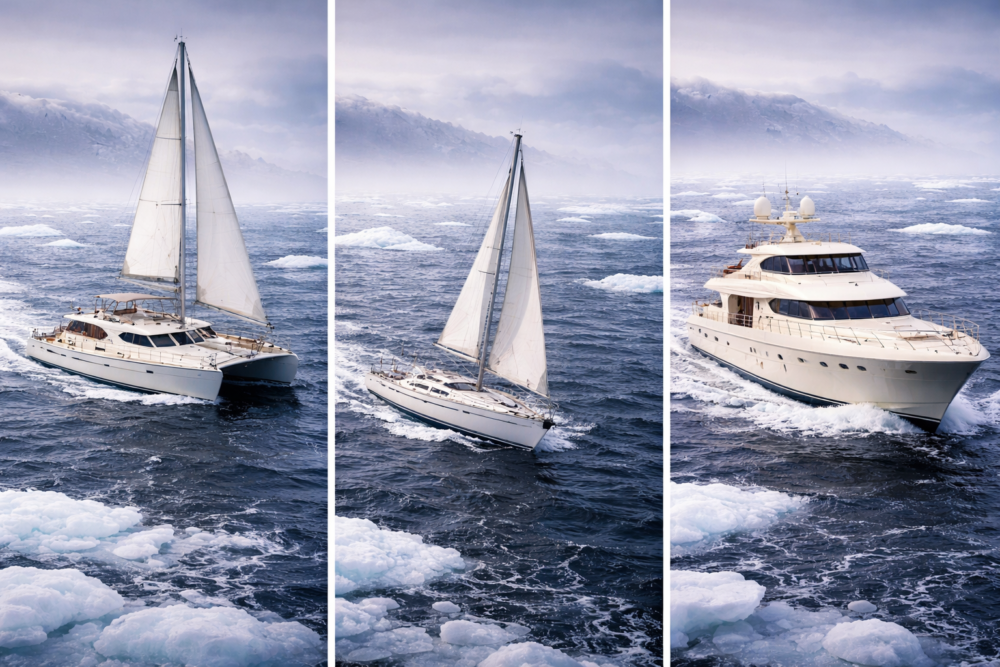
Powerboat Delivery from Singapore to Subic Bay on an Azimut 53
A powerboat delivery from Singapore to Subic Bay on an Azimut 53 is a viable offshore passage, but it is not a routine motor yacht transfer. While the distance—approximately 1,300 nautical miles—is manageable, the South China Sea introduces timing, fuel, and sea-state constraints that must be respected if the delivery is to remain controlled rather than reactive.
The route typically tracks north through the South China Sea before shaping east toward the Philippines, often passing west of Palawan before turning toward Luzon. Once clear of Singapore, this is a largely offshore passage with limited diversion options, particularly during unfavourable weather phases. For a planing motor yacht, the objective is not speed but maintaining safe and fuel-efficient sea angles over extended running periods.
Timing is the dominant risk factor. The most reliable delivery window is generally March through May, when the Northeast Monsoon has weakened and sea states are more manageable. During this period, routing flexibility is higher and fuel consumption more predictable. September and October can be workable but are conditional, with increased squall activity and a greater need for conservative decision-making. December through February is typically avoided due to persistent head seas and short-period wave patterns that significantly increase structural loading, fuel burn, and crew fatigue on vessels of this type.
Fuel planning for an Azimut 53 requires realism rather than optimism. Although capable, the vessel is not designed as a long-range displacement yacht. Consumption figures must be calculated using conservative cruise settings and adjusted for adverse sea states rather than flat-water performance data. Refuelling options along the route must be identified in advance, and the passage plan structured to avoid forcing refuel decisions late in the voyage. Weather routing is used primarily to reduce fuel-inefficient headings, not to shorten distance or maintain schedules.
From a technical perspective, this delivery places sustained load on machinery rather than short coastal running hours. Cooling systems, fuel filtration, and redundancy in navigation and communications are critical. Stabiliser condition, if fitted, also becomes relevant once the vessel encounters beam or quartering seas for prolonged periods. The goal is to reduce small technical issues becoming operational constraints offshore.
Clearance and compliance are straightforward but must be handled precisely. Singapore export clearance is efficient but time-sensitive, while Philippine entry requires correct port designation and advance coordination. Crew documentation must reflect delivery operations rather than charter or private cruising, as misclassification can cause avoidable delays on arrival.
For owners evaluating whether to run this passage themselves, the principal risks are rarely boat handling. They are more commonly related to timing errors, fuel miscalculation, and overconfidence in marginal weather windows. Professional delivery planning focuses on eliminating forced decisions mid-passage and preserving mechanical margin, rather than meeting arbitrary deadlines.
In summary, a Singapore to Subic Bay delivery on an Azimut 53 is entirely achievable when planned around seasonal conditions, conservative fuel management, and disciplined routing. When those factors are ignored, the same passage becomes unnecessarily hard on both vessel and crew. For owners requiring professional powerboat delivery in Southeast Asia, this route is best approached as a managed offshore transit rather than a fast relocation.