
This multi-hull delivery involved a Lagoon 450 cruising catamaran relocating from Hong Kong to Palawan in the Philippines. The vessel was privately owned and fully equipped for offshore passage-making, with the delivery covering a mix of high-traffic coastal waters, open-sea legs, and archipelagic navigation on arrival.
Catamarans of this size and type are well suited to long-range passages, but they require careful planning around weather, systems load, and fuel management, particularly when operating across regions with variable traffic density and limited diversion ports.
Pre-departure work focused on systems reliability and redundancy rather than cosmetic preparation. Particular attention was given to:
Engine servicing and spares
Electrical load management and charging capacity
Steering and autopilot systems
Rig inspection, sail handling systems, and deck hardware
Communications and tracking equipment
Passage planning considered seasonal weather patterns in the South China Sea, commercial shipping density, and realistic daily run expectations for a catamaran of this displacement. 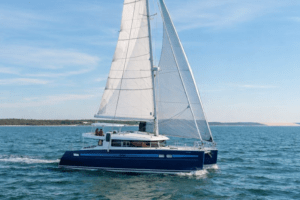 The objective was steady progress with conservative margins rather than maximising speed.
Departure from Hong Kong required coordination with heavy commercial traffic and careful timing to exit major shipping lanes cleanly. Once clear of coastal congestion, the passage transitioned into extended offshore running across the South China Sea.
Conditions during the offshore leg were typical for the season, with periods of moderate trade winds and variable sea state. The Lagoon 450’s wide beam and twin-hull configuration provided a stable motion profile, reducing fatigue over long watches and allowing consistent sail or motor-sail progress depending on conditions.
Weather routing was adjusted en route to manage squall activity and avoid unnecessary stress on the rig and systems.
As the vessel approached the Philippine archipelago, navigational priorities shifted from offshore routing to close-range pilotage. Increased fishing traffic, variable lighting, and local vessel movements required heightened situational awareness, particularly during night operations.
The Lagoon 450’s shallow draft and manoeuvrability were advantageous when navigating island passages and preparing for arrival. Fuel management, watch rotation, and ongoing systems checks continued through to final landfall.
The vessel arrived in Palawan in good condition, with no damage or mechanical issues arising during the passage. Arrival formalities were completed efficiently, and the yacht was secured ready for owner use.
A post-delivery condition report was provided, covering systems status, consumables used, and any observations relevant to future operation in the region.
Long-range multihull deliveries in Asia require more than straightforward passage-making. Traffic density, weather variability, and regional operating realities demand planning, judgement, and adaptability rather than rigid schedules.
This Hong Kong to Palawan delivery is representative of the type of work we undertake regularly across Southeast Asia: managing complex passages conservatively, maintaining clear communication, and delivering vessels in service-ready condition.
 For owners relocating cruising catamarans within Asia or into the Pacific, this approach reduces risk and avoids unnecessary wear on the vessel.